Chinese EV Public Charging: Test Your Real Route
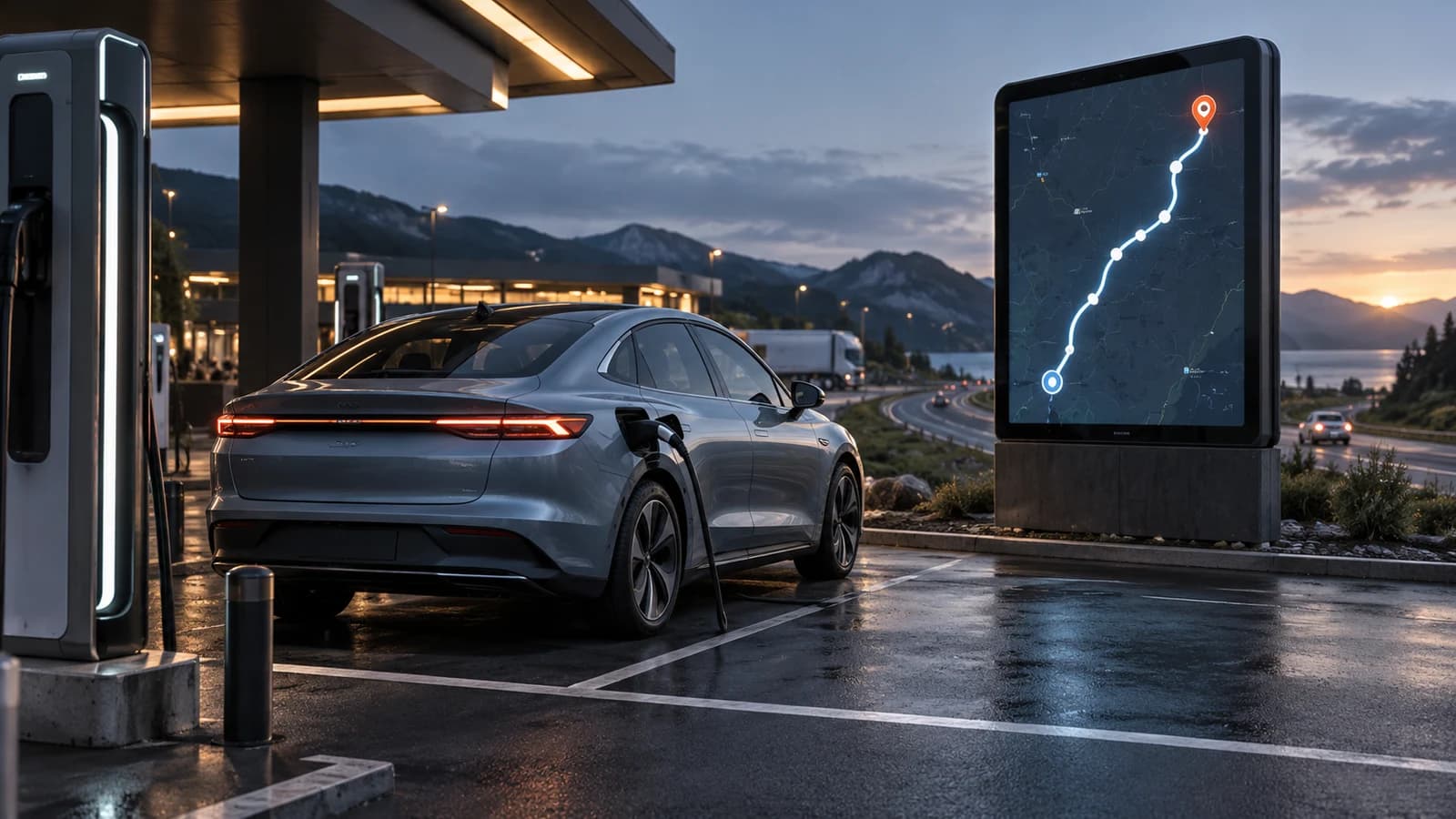
Direct answer. Test the imported Chinese EV on the public charging services that matter to your real route, using supported equipment and an authorized, safe trial. Record compatibility, access, payment and the actual observed session. A map listing or matching-looking connector does not establish that the vehicle can reliably use every station on the journey.
Key takeaways
- Select representative stops from the intended route.
- Verify supported vehicle and charger compatibility before attempting a session.
- Test the relevant access and payment process under the owner's account.
- Record conditions rather than promising a universal charging speed.
- Establish a supported fallback and assistance route.
Define the journey before selecting a station
Describe the ordinary route, parking duration and important stops. A city commuter, a regional driver and a fleet shift can have different public charging needs. Choose a small set of representative services rather than assuming that one convenient showroom charger answers the ownership question.
Identify which charging stops are essential and which are optional. The essential stops need stronger evidence before the purchase relies on them. If the route is only planned, label the assumptions and consider a bounded trial instead of presenting it as a verified daily routine.
An online charging map is a discovery tool. Confirm the operator's current information and the conditions relevant to the actual site. A marker cannot prove equipment availability, supported access or practical suitability at the time of travel.
Verify compatibility before connecting
Identify the exact vehicle configuration and obtain the applicable manufacturer information. Ask competent providers about the supported charger and equipment combination. Physical resemblance between connectors is not a complete compatibility finding.
If an adapter is proposed, obtain the relevant authorized confirmation for the vehicle, equipment and use. Do not connect an unverified device simply to see whether the session starts. This guide supplies no conversion or electrical-work instructions and does not approve any accessory.
Distinguish an origin-market demonstration from the destination arrangement. A video of the car charging in China can establish a particular observation there, but it does not prove the owner can access every service abroad. Keep those evidence boundaries explicit in the purchase discussion.
Record a representative authorized session
| Item | Observation to preserve |
|---|---|
| Vehicle | VIN or controlled vehicle identifier and configuration |
| Site | Operator, location and relevant equipment identity |
| Access | Supported account or payment method used |
| Conditions | Date and relevant starting circumstances |
| Outcome | Session result and observed limitations |
| Support | Contact and agreed next step for a failure |
Follow the applicable vehicle and operator instructions. A warning, damage concern or unsupported combination should stop the ordinary trial pending competent advice. Do not repeatedly reconnect or change electrical equipment without authorization to create a positive result.
Test access and payment as separate dependencies
Ask whether the owner can establish the required supported account and payment arrangement. A supplier's borrowed account may conceal a registration or billing limitation. Complete the trial from the new owner's position where the provider permits it.
Record whether the access route worked and what costs or conditions were disclosed. Do not infer a future tariff from one historical receipt. For a fleet, ask how sessions are authorized and reconciled without sharing unnecessary driver information.
If a service uses a network connection or app, ask what supported response applies when that dependency is unavailable. A charger can be technically compatible while the payment route prevents ordinary use. Keep the operational failure distinct from a vehicle defect until the competent provider investigates.
Interpret charging performance narrowly
Record the result under the actual conditions and the provider's relevant explanation. Do not convert one session into a guaranteed speed or fixed stop duration for every journey. The vehicle and equipment instructions should inform any assessment of expected behavior.
If observed performance does not meet the intended route requirement, investigate the reason with competent providers. The useful purchase question is whether the verified arrangement supports the buyer's task, not whether a single peak figure matches an advertisement.
Public charging guidance from the U.S. Department of Energy provides general infrastructure context. It does not validate an individual Chinese-market EV's compatibility or your destination route. The vehicle-specific confirmation and authorized local observation supply the evidence needed for this decision.
Design a supported fallback
Identify an alternative that has its own verified support route. Do not assume the next map marker is usable or that any ordinary outlet can rescue a failed stop. The fallback should account for the actual car, access arrangements and applicable safety instructions.
Ask who the driver contacts when a session cannot start or safely complete. The operator, vehicle support provider and roadside assistance service may have different responsibilities. Keep those contacts accessible without placing sensitive credentials in a public document.
Use the charging compatibility checklist to establish the equipment question and the adapter safety guide to keep unsupported changes out of the plan. A route is ready when essential stops and contingencies have an evidence-based support arrangement, not when a map looks well covered.
Revisit the route when a dependency changes
Set review triggers such as an operator changing its access process, an essential site becoming unavailable or the vehicle receiving an authorized change that affects the supported arrangement. The owner should confirm the current position with competent providers rather than repeatedly relying on an old successful receipt. For a fleet, tell dispatch which stop is no longer verified and who owns the alternative decision. A route record is useful only when users can distinguish current evidence from a historical observation that no longer supports the journey.
Frequently asked questions
Does the same connector shape guarantee charging?
No. Obtain the relevant supported compatibility finding for the actual vehicle and equipment before attempting the session.
Can I use the seller's account for the acceptance test?
It can leave ownership access unverified. Test the supported new-owner arrangement where possible and record any remaining dependency.
Does one successful fast-charge session prove the entire route?
No. It supports that observed combination and conditions. Verify the essential services and the authorized fallback separately.
Sources
- U.S. DOE: charging electric vehicles in public — general infrastructure context.
- U.S. DOE: EV consumer information — general ownership context, not vehicle-specific compatibility.